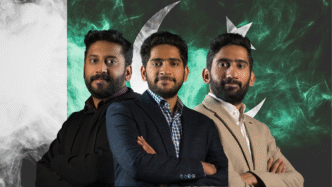

In an era where artificial intelligence is dominated by trillion-dollar giants, three Pakistani co-founders have done the unbelievable — and the world is taking notice.
Vyro.ai, the Pakistan-born startup behind the groundbreaking text-to-image platform ImagineArt, has officially climbed to #3 globally on the industry’s most competitive leaderboard. In the same rankings, ImagineArt stands shoulder-to-shoulder with — and in several benchmarks surpasses — category titans such as Midjourney, Adobe, Microsoft, Google, Runway, OpenAI, Flux, Ideogram, Alibaba, Leonardo, and Recraft.
This is not just a technological milestone.
It is a defining moment for Pakistan’s global tech narrative. 
A Story of Three Founders Who Refused to Be Outpaced
Behind ImagineArt’s rise are three founders, Ahmed Abu Bakr as CEO and Co-Founder, Abdullah Rafiq as CTO and Co-Founder and Zain ul Abedien as COO and Co-Founder have built Vyro.ai from scratch in Pakistan, in a market where startups typically lack access to the massive compute, venture backing, or distribution channels enjoyed by Silicon Valley incumbents.
Yet — with strategic focus, product-market fit, and relentless iteration, they managed to do what few thought possible.
Where industry giants use vertically integrated ecosystems and billion-dollar cloud budgets, Vyro relied on engineering excellence, efficiency, and an obsession with real user needs. This difference, ironically, became Vyro’s competitive advantage.
ImagineArt 1.5: The Model That Surprised the World
The release of ImagineArt 1.5 didn’t just spark attention — it disrupted global expectations of where world-class AI innovation can come from.
For years, the frontier of text-to-image AI has been shaped almost exclusively by heavyweight ecosystems: Silicon Valley labs with billion-dollar budgets, Chinese cloud giants with unlimited compute, and European institutions built around strong research networks.
These players dominate because they control what the industry calls the three pillars of power:
- Compute — massive GPU clusters
- Foundation models — proprietary architectures
- Distribution — platforms with hundreds of millions of users
In this tightly guarded global ecosystem, breakthroughs typically emerge from tech giants with thousands of researchers and huge R&D pipelines.
And yet
ImagineArt 1.5, a model built in Pakistan, forced its way into the same tier.
Across the world’s most competitive categories:
- Overall Text-to-Image
- Photorealism
- General Image Generation
ImagineArt 1.5 ranked above or alongside models from the most advanced AI labs in the United States, Europe, and China.
This was not supposed to happen — not according to the industry’s traditional power hierarchy.
What shocked experts wasn’t just performance metrics; it was how ImagineArt achieved them.
The model demonstrates:
- Unusually high realism
- Strong consistency in multi-attribute prompts
- Fine-grained visual control
- Stable character repetition and identity retention
These are capabilities typically seen only in models backed by multimillion-dollar R&D budgets and vertically integrated compute infrastructure.
ImagineArt 1.5 proved that a smaller, independent team — operating outside the world’s dominant AI hubs — could compete at the highest global level.
And while doing this, Vyro crossed $23M ARR, something even well-funded Western AI startups rarely reach so early.
This shift signifies something bigger than a product milestone.
It represents a geopolitical moment in AI:
- Pakistan is not just catching up — it is entering the frontier layer of global AI development.
- The global AI race is no longer restricted to a handful of countries.
- Independent, emerging-market startups can challenge entrenched superpowers.
ImagineArt 1.5 isn’t just a model.
It is a proof point — that talent, focus, and innovation can outperform scale, money, and historical advantage.
And that Pakistan is now firmly — and visibly — part of the global AI conversation.
A Disruptive Player in a Fiercely Competitive Industry
The global AI-for-marketing and creative AI sectors are among the toughest on the planet. The giants — Adobe, Google, OpenAI, ElevenLabs, Freepik — are rapidly acquiring, consolidating, and expanding into all-in-one creative suites. Their aim is simple: lock in the entire user workflow.
Competing against this kind of structural power is near impossible for an independent startup.
Yet Vyro did.
Not only did they stand their ground — they outperformed.
ImagineArt’s superior model performance proves a truth often overlooked:
Talent, innovation, and discipline beat deep pockets when the product strategy is right.
A Landmark Moment for Pakistan’s Tech Identity
Pakistan is often excluded from global innovation narratives.
Vyro.ai just changed that.
This achievement shows:
- Pakistan can build world-class AI products.
- Pakistani founders can compete with — and surpass — leading global labs.
- Local innovation can scale globally without waiting for permission, validation, or external rescue.
With ImagineArt now among the top three AI image models in the world, it sends a message across borders:
Pakistan has the talent. Pakistan has the capability. Pakistan is not behind — it is rising.
The Road Ahead
Vyro is not stopping here. With the introduction of new features, including a collaboration-driven creative suite designed for marketers and agencies, they are positioning ImagineArt as a next-generation creative platform.
And if history is any indication, they will continue to grow, innovate, and push boundaries — proving again that world-class breakthroughs can come from anywhere.
Especially from Pakistan.