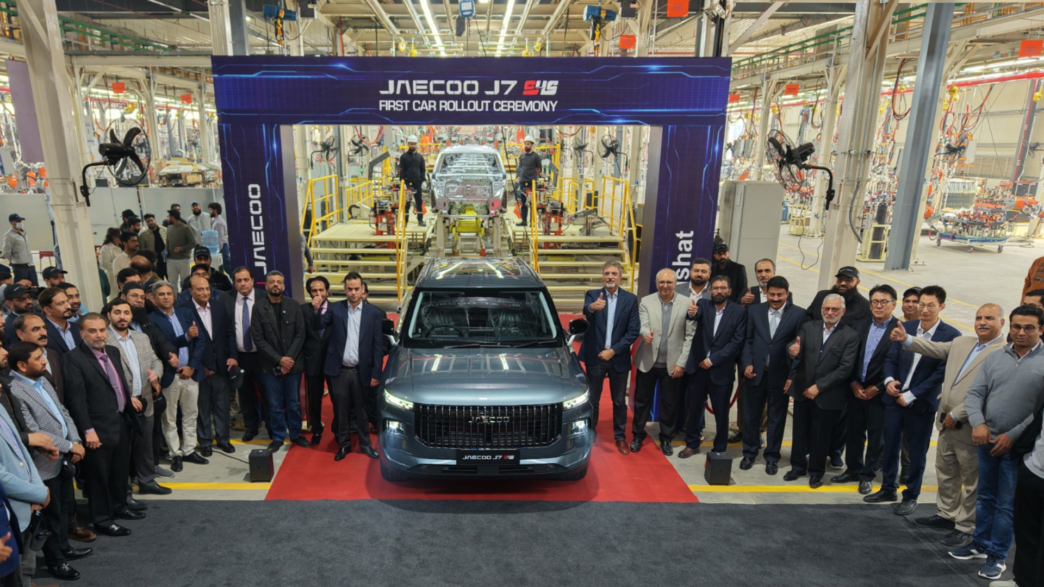
Omoda & Jaecoo’s decision to begin local production of the Jaecoo J7 SHS plug-in hybrid in Pakistan marks more than the arrival of another SUV badge in an increasingly competitive market. It represents a strategic inflection point for a country that has historically relied on imports for technologically advanced vehicles and is now testing its ability to move up the automotive value chain. The speed of execution has been striking: following the model’s local unveiling in October, the first locally assembled unit rolled out of Nishat Motors’ new Faisalabad facility in early December, compressing what is often a multi-year localisation journey into a matter of months.
The pace matters because it begins to change the economics of mobility in Pakistan. For decades, the domestic auto sector has been shaped by foreign-exchange constraints, volatile import duties, and chronic supply bottlenecks that translated into long waiting periods and abrupt price resets for consumers. Local assembly of the J7 SHS signals a shift toward a more resilient, investment-led model; one that anchors production, pricing, and delivery timelines closer to domestic demand rather than external shocks.
The product itself is calibrated for markets where electrification must coexist with infrastructure realities. The Jaecoo J7 SHS pairs a 1.5-litre turbocharged petrol engine with an 18.3 kWh lithium-iron-phosphate battery, delivering an electric-only range exceeding 90 kilometres under NEDC standards and a total driving range of more than 1,200 kilometres. In practical terms, it offers urban commuters the benefits of electric driving while retaining the flexibility of internal combustion for longer intercity travel. For Pakistani consumers, that balance lowers adoption risk and positions plug-in hybrids as a realistic bridge toward fuller electrification. 
Nishat Group’s investment in its Faisalabad plant, configured for CKD assembly of hybrid platforms, reduces exposure to currency volatility and import-related cost pressures while allowing pricing to reflect local market dynamics. The introductory ex-factory pricing of the J7 SHS places advanced hybrid technology within reach of a broader segment of middle-income buyers, while incremental localisation over time opens the door to retaining a greater share of value within Pakistan’s industrial ecosystem.
Crucially, the implications extend beyond vehicles and tariffs to employment and industrial capacity. Rising order volumes and increased plant utilisation are supporting thousands of direct jobs across manufacturing, quality control, logistics, and technical operations, while creating additional demand in dealerships, parts supply, transportation, and after-sales services. Globally, the automotive sector typically generates an employment multiplier of 2.5 to 3 times direct factory jobs, suggesting that sustained local production could support a far wider base of livelihoods. In an economy where industrial job creation has struggled to keep pace with demographic growth, that multiplier effect may prove as strategically important as the technology itself.
The geopolitical dimension is equally significant. China’s broader pivot toward export-led growth in new-energy vehicles has increasingly relied on embedding production capacity in overseas markets rather than shipping fully built units. From Southeast Asia to Africa, Chinese OEMs have partnered with local industrial groups to scale volume, localise costs, and accelerate consumer adoption. Pakistan’s inclusion in that map is timely. Other global players, including BYD, have already signalled plans for local assembly, setting the stage for a competitive landscape that can drive faster infrastructure development and policy engagement than an import-only model ever could.
For policymakers, the benefits are immediate and tangible. Local assembly shortens supply chains, reduces inventory lead times, and creates a platform for skills transfer in hybrid powertrain servicing, battery management, and vehicle electronics. It also offers a live test case for designing incentives and regulatory frameworks that support domestic manufacturing rather than simply taxing imported hardware. If sustained, such initiatives can catalyse supplier development and vocational training, laying the groundwork for deeper industrial capability.
There are, inevitably, risks involved. Localisation will be gradual, and genuine technology transfer depends on predictable policy, supplier development, and workforce training. Without those elements, assembly plants risk becoming long-term transshipment points rather than engines of industrial upgrading. Yet the alternative, continued reliance on fully built imports, offers little upside, leaving the economy exposed to currency swings while delivering minimal gains in skills or capital formation.
Against that backdrop, the local production of the Jaecoo J7 SHS should be read as a test of Pakistan’s industrial intent. If the Faisalabad rollout catalyses complementary investments in components, training, and charging infrastructure, it may mark the beginning of a more resilient automotive sector. The J7 SHS is not merely a new vehicle entering the market; it is an early signal that Pakistan is beginning to treat mobility as an industrial opportunity rather than a consumption expense.