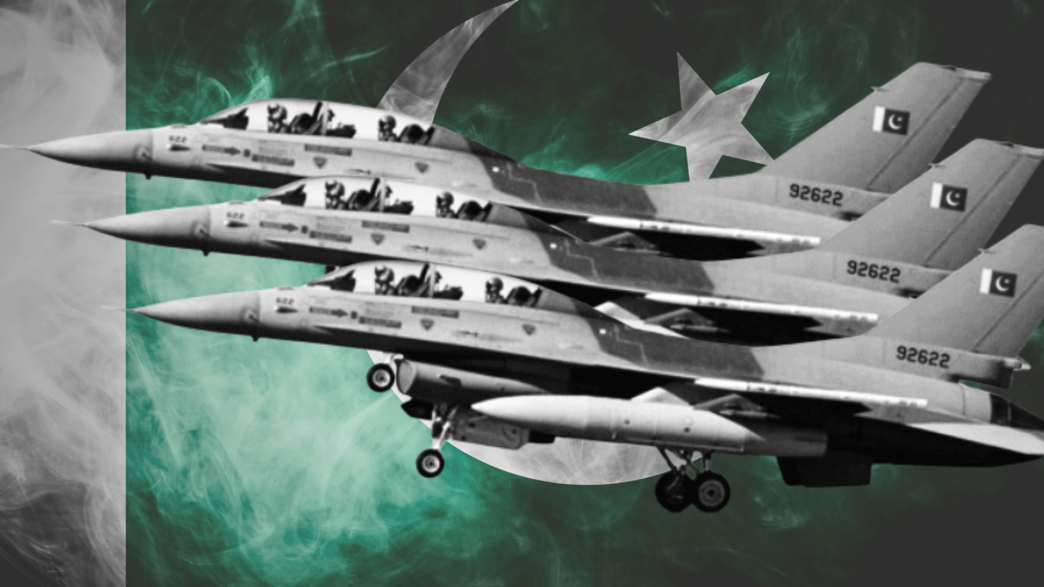
Pakistan is set to significantly enhance the combat capability of its F-16 fighter fleet with the integration of Link-16 tactical data link technology, following the US approval of a $686 million upgrade and sustainment package on December 8th, 2025. The move represents one of the most consequential upgrades to Pakistan Air Force (PAF) operations in more than a decade, shifting its F-16s firmly into the realm of network-centric warfare.
Earlier, the US has restricted Pakistan’s use of American-supplied fighter jets against India due to End-User Agreements and geopolitical concerns.
The F-16s were provided for counter-terrorism purposes (especially in the context of Afghanistan), not conventional war against other states, particularly India. Any misuse can lead to suspension of spares, maintenance contracts, or even sanctions. However, following the current Trump’s has committed to a deal which allows Pakistan to upgrade it’s air combat capabilities by integrating Link-16 terminals for holistic aerial viisbility. 
The upgrade goes beyond routine maintenance. At its core is the introduction of Link-16 terminals, secure communications, and avionics modernisation, allowing Pakistan’s F-16s to exchange encrypted, near-real-time battlefield data with other air, land and maritime platforms.
Networked Air Combat Capability
Link-16 is a secure, jam-resistant digital network used by the US, NATO and allied forces to share tactical information such as aircraft positions, target tracks, threat warnings and mission commands. Once integrated, Pakistan’s F-16s will no longer operate as isolated platforms but as nodes within a shared combat network.
This enables pilots to see a common operational picture drawn from multiple sensors, including airborne early warning aircraft, ground-based radars and other fighters rather than relying solely on their own onboard systems. In practice, this reduces reaction time, improves targeting accuracy and enhances survivability in contested airspace.
Beyond Radar-Only Limitations
While radar upgrades improve how far or how clearly an individual aircraft can detect targets, they remain platform-limited. A fighter can only engage what it can see or track independently.
Link-16 fundamentally changes that equation.
With data links, a target detected by one platform can be engaged by another, even if the latter’s radar has not yet locked on. This allows for cooperative engagements, better airspace management and coordinated defensive or offensive operations, a decisive advantage in modern air combat.
In essence, radar upgrades sharpen a fighter’s eyes; Link-16 connects all eyes and shooters across the battlespace.
Operational and Strategic Impact
For Pakistan, the integration of Link-16 delivers multiple operational benefits:
- Force multiplication: Faster sensor-to-shooter loops and shared targeting data improve combat effectiveness without increasing fleet size.
- Enhanced counterterrorism operations: Improved coordination between air assets and ground forces enables more precise, time-sensitive strikes.
- Interoperability: Alignment with US and allied communication standards strengthens Pakistan’s ability to operate in joint or coalition environments.
- Fleet longevity: The broader upgrade package extends the operational life of Pakistan’s F-16s into the 2040s, preserving a critical pillar of its airpower.
Strategic Signalling
The approval also carries geopolitical weight. It signals continued US-Pakistan defence cooperation at a time of rapid military modernisation across South Asia. While Washington has emphasised that the upgrade is intended for counterterrorism and defensive purposes, the operational gains are clear and enduring.
For the Pakistan Air Force, Link-16 represents a qualitative leap rather than a numerical one — embedding its F-16 fleet into a digital combat architecture where information dominance is as decisive as firepower.
Bottom Line
The integration of Link-16 transforms Pakistan’s F-16s from capable multirole fighters into fully networked combat assets. In an era where air warfare is increasingly decided by connectivity, data fusion and speed of decision-making, this upgrade materially strengthens Pakistan’s aerial posture — well beyond what radar improvements alone could deliver.