Psychology is often associated with modern phenomena, whereas the truth is surprisingly different. Modern psychology began in 1879 when German physician and philosopher Wilhelm Wundt established the world’s first experimental psychology laboratory at the University of Leipzig, Germany. Whereas the Quran placed strong emphasis on human psychology 1400 years ago by outlining a complete framework for understanding human behavior, emotional health, motivation, spiritual growth, and personal transformation.
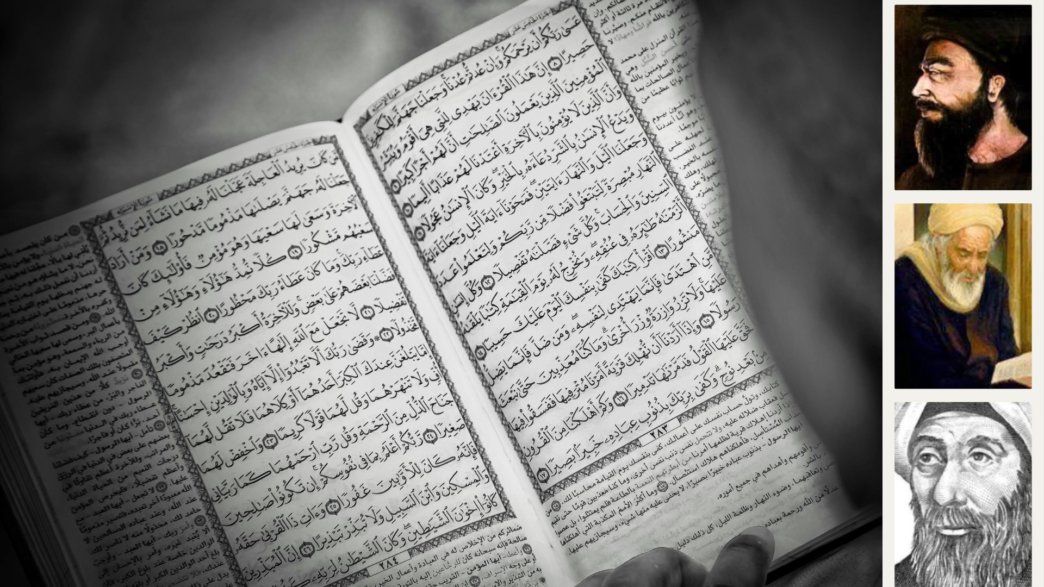
If I have to set a precedent from Muslim scholars, Abu Zayd al-Balkhi, a 9th-century Muslim psychologist, was one of the earliest pioneers of Islamic psychology and mental health during the Islamic Golden Age. In his landmark work, Masalih al-Abdan wa al-Anfus (Sustenance for Bodies and Souls), he systematically classified conditions such as depression, anxiety, phobias, and obsessive thoughts, while emphasising the close relationship between physical and psychological health. His therapeutic approach, challenging negative thoughts through rational thinking, self-reflection, and emotional regulation, sets the principles of Cognitive Behavioral Therapy (CBT), which was further developed over a thousand years later by Western psychologists.
Al-Balkhi was part of a remarkable tradition of Muslim scholars who advanced the science of the human soul. Al-Muhasibi pioneered structured self-accountability (muhasabah) and spiritual psychology; Al-Ghazali developed a comprehensive framework for understanding the diseases of the heart and character formation; while Ibn al-Qayyim further explored the relationship between the soul, behaviour, and spiritual healing. Together, these scholars laid the foundations of psychology centuries before psychology emerged as a formal academic discipline in the modern West. 
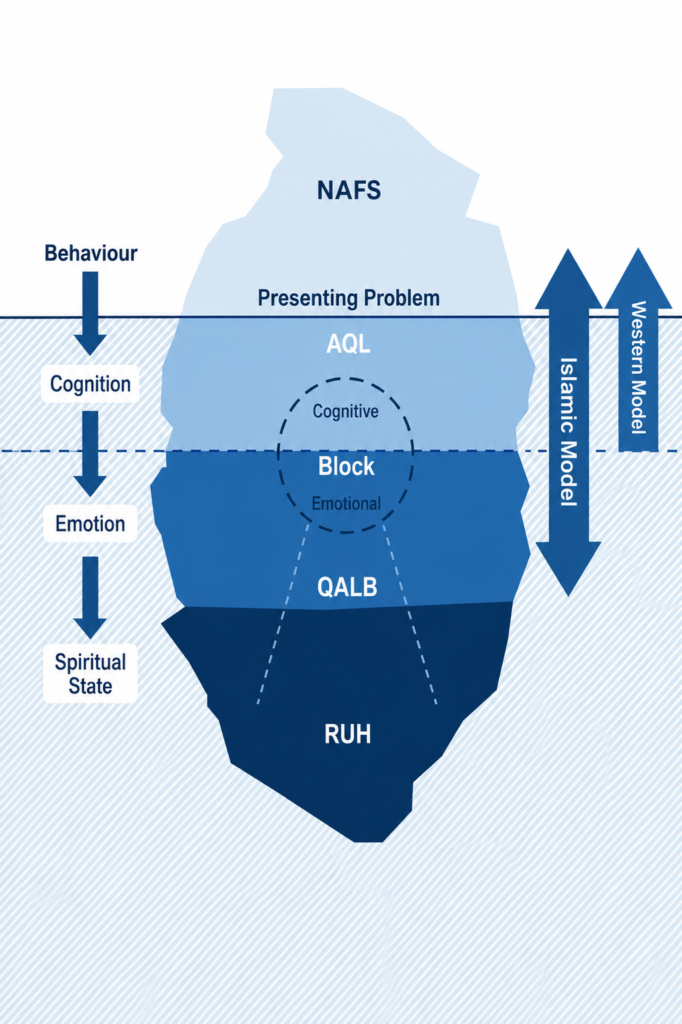
At the heart of this framework are four interconnected dimensions that every Muslim should understand: the Nafs, Qalb, Ar Ruh, and Fitrah. These are real, distinct parts of you; each one needs its own kind of attention. Let’s discuss one at a time, and for each, I will explore a working definition and a way to recognise it within ourselves.
1. The Nafs – The Self That Wants
The nafs is often misunderstood as something evil that must be suppressed. Islam never teaches to overlook nafs and its calling; in fact, it reminds us to pause and reflect on it – whether or not to follow it or ignore it, unlike the Western outlook of a lower self, followed by Freud in his id. In the Freudian model, the id is an animal-like pure drive, pure appetite, requiring not to be listened to, and to be fulfilled as its liking – the nafs in Islamic tradition is not an animal. In fact, it is an intimate part of the human being that needs to be trained, like a muscle that needs to be developed, like a horse that needs to be broken in and ridden, not killed. In short, nafs is yours; you cannot get rid of it, and you should not want to. But if it is untrained, it commands you towards what is harmful. If it’s trained, it becomes one of the most precious resources you can carry through this life. So, nafs, the part of you that wants, constant, trainable, yours, not evil.
The nafs is simply the part of us that says:
- I want.
- I deserve.
- I’m hungry.
- I’m offended.
- I don’t feel like doing this.
It is the seat of desire, motivation, and instinct.
The problem is not that the nafs exists.
The problem is an untrained nafs.
Islam compares it to a powerful horse. Left untamed, it drags its rider wherever it wishes. Properly trained, however, it becomes one of the greatest assets a believer possesses.
The goal is therefore never self-hatred. The goal is self-discipline. In this very moment, it is important to split open the level of Nafs that the Quran highlights in order: Nafs e Ammarah, Nafs e Lawwama, and Nafs e Mutmainna. To share a glimpse of it, let’s take a look at an ayah of Surah Yusuf.
The Three States of the Nafs
The Qur’an identifies three primary conditions of the self.
- What is Nafs al-Ammarah
The commanding self. “Indeed, the soul is certainly inclined to evil, except those upon whom my Lord has mercy. Surely my Lord is All-Forgiving, Most Merciful.” – Surah Yusuf (12:53)
This is the state where desires control behaviour almost automatically.
“I couldn’t help myself.” “It just happened.”
There is no pause between impulse and action.
- What is Nafs al-Lawwamah
“And I swear by the self-reproaching soul.” – Surah Al-Qiyamah (75:2)
Although brief, Allah swears by this state of the soul, highlighting its significance in repentance, self-accountability (muhasabah), and spiritual growth.
The self-reproaching soul.
Here, two voices begin to emerge.
One wants. The other knows better.
This internal struggle is not failure.
It is actually evidence that spiritual awareness has begun.
The believer starts to recognise mistakes, take responsibility, and engage in sincere repentance.
- What is Nafs al-Mutma’innah
The tranquil soul.
Contrary to popular belief, this does not mean a life without difficulty.
It means becoming inwardly stable despite life’s difficulties.
Praise no longer inflates the ego.
Criticism no longer destroys it.
“O tranquil soul! Return to your Lord, well-pleased and well-pleasing. Enter among My servants, and enter My Paradise.” – Surah Al-Fajr (89:27–30)
The believer remains anchored because peace now comes from closeness to Allah rather than external validation.
2. The Qalb – The Heart That Perceives
Modern culture treats the heart as the centre of emotion.
Islam describes something far more profound. The qalb is the organ of perception.
It is through the heart that a person recognises truth, sincerity, arrogance, hypocrisy and ultimately Allah.
When the heart is healthy, reality becomes clearer. When it is diseased, reality becomes distorted.
This is why classical scholars developed remarkably detailed classifications of the diseases of the heart, including:
- arrogance (kibr)
- envy (hasad)
- showing off (riya)
- self-admiration (‘ujb)
- heedlessness (ghaflah)
- resentment (hiqd)
- miserliness (bukhl)
These were not merely theological concepts. They were clinical observations about recurring patterns of human behaviour that continue to affect people today.
In Surah Al-Hajj (22:46), the Quran highlights the heart as an organ of reasoning, understanding, and perception: “Have they not traveled through the land so that they may have hearts by which to reason and ears by which to hear? Indeed, it is not the eyes that are blind, but it is the hearts which are in the chests that are blind.”
Modern neurocardiology echoes this ancient truth. Research shows that the human heart contains its own intrinsic nervous system, a complex network of about 40,000 sensory neurons. These cells can sense, process information, learn, and remember independently, constantly sending critical emotional and logical signals to the brain.
“O mankind! There has come to you an admonition from your Lord and a healing for the diseases in your hearts, and for those who believe, a Guidance and Mercy.” (Surah Yunus, 10:57)
Now link it back to the framework of Islamic psychology – Qalb is the second highlight, and human psychology is intertwined with it.
There is a famous Hadith (a recorded statement of Prophet Muhammad) found in the authentic collections of Sahih al-Bukhari and Sahih Muslim. The exact wording is: “Beware, in the body there is a piece of flesh; if it is sound, the whole body is sound, and if it is corrupt, the whole body is corrupt, and hearken, it is the heart.”
3. The Ruh – The Divine Dimension
Unlike the nafs or the qalb, the ruh is not something psychology can fully explain.
The Qur’an itself limits speculation regarding it. The ruh originates from Allah’s command. When the Prophet Muhammad was questioned about the soul, he was instructed to reply that it is a mystery known only to Allah.
Surah Al-Isra 17:85: “And they ask you, [O Muhammad], about the soul. Say, ‘The soul is of the affair of my Lord. And mankind have not been given of knowledge except a little.”
Importantly, the ruh itself cannot be damaged. What becomes damaged is our connection to it.
When Muslims describe feeling spiritually empty, disconnected, or numb, Islam teaches that the soul has not disappeared or damaged; it has simply become disconnected through neglect.
The nourishment of the ruh has always remained constant:
- Qur’an
- Salah
- Dhikr
- sincere worship
Just as the body weakens without food, the ruh weakens when deprived of remembrance.
4. The Fitrah – Humanity’s Original Nature
Perhaps one of Islam’s most hopeful teachings is the concept of fitrah.
Every human being is born with an innate inclination toward truth, goodness, and Allah.
This natural disposition cannot be destroyed. It can only become covered.
Sin, trauma, culture, distractions, and neglect may bury it beneath layers of darkness, but they never erase it. “Indeed, I have turned my face toward He who created the heavens and the earth, inclining toward truth, and I am not of the polytheists.” (Prophet Ibrahim’s declaration serves as the ultimate example of following one’s pure Fitrah).
This explains why many people experience sudden moments of awakening after hearing a verse of Qur’an, the Adhan, or a sincere reminder.
Islam understands these moments not as something new entering the heart, but as something ancient being rediscovered.
The term Fitrah refers to the pure, innate, and God-given disposition of human beings to recognize truth, goodness, and the Oneness of God (Tawhid). This fundamental concept is highlighted in several places in the Quran, most famously in Surah Ar-Rum.
Surah Ar-Rum (30:30): “So direct your face toward the religion, inclining to truth. [Adhere to] the fitrah of Allah upon which He has created [all] people. No change should there be in the creation of Allah. That is the correct religion, but most of the people do not know.”
Excellence Begins With Inner Awareness
Modern self-improvement often focuses on material gains, productivity systems, routines, and worldly achievement.
Islam begins somewhere deeper.
It asks:
- What condition is your heart in?
- Which state is your nafs operating from?
- What diseases have quietly settled within your character?
These questions are not abstract theology. They are practical diagnostics for everyday life.
Every argument, temptation, success, and setback becomes an opportunity for self-observation.
This practice of self-accountability, also known as muhasabah, has been part of the Islamic tradition for over a thousand years.
Success Is Defined Differently in Islam
The Qur’an does not define success primarily by wealth, influence, or status.
It defines success by purification.
A successful believer is not necessarily the one who accumulates the most achievements.
It is the one who gradually trains the nafs, purifies the heart, nourishes the ruh, and protects the fitrah.
That journey lasts a lifetime and sets you on a path of success in the living world and the hereafter.
“Successful indeed is the one who purifies their soul, and ruined is the one who corrupts it.” (Surah Ash-Shams, 91:9-10)
Islam never promised instant transformation. It promises that every sincere step toward Allah transforms the person taking it.
The greatest investment a Muslim can therefore make is not merely in external success, but in understanding the inner self exactly as Allah designed it.
For the believer, mastering the inner world is not optional.
It is the foundation upon which every lasting achievement in this life and the next is built.
This foundation in early Islamic psychology was later expanded and refined by other scholars who further systematised the understanding of the human mind.
Building on these ideas, subsequent thinkers developed more structured approaches to mental health, behaviour, and emotional balance within an Islamic framework.
This article is inspired by the teachings of Dr Francesca Bocca Aldaqre, a psychologist by training who holds a doctorate in systemic neuroscience. She spent many years inside the Western psychological tradition – first as a student, then as a researcher, and then also as a practitioner. Currently, a founder of Shams, Studio di Psicologia Islamica – The first Islamic Psychology Initiative for Muslims in Italy. Education and Counselling Services.